
 Alfred Harper
I’ve put Bosch and Nilfisk head‑to‑head — which one blasts grime faster and saves me money?
Ready for a power wash showdown? I introduce the Bosch EasyAquatak 110 and the Nilfisk Core 130, summarising core differences in pressure, power and intended use so readers can quickly choose which machine suits their cleaning needs, and budget considerations.
Budget Compact
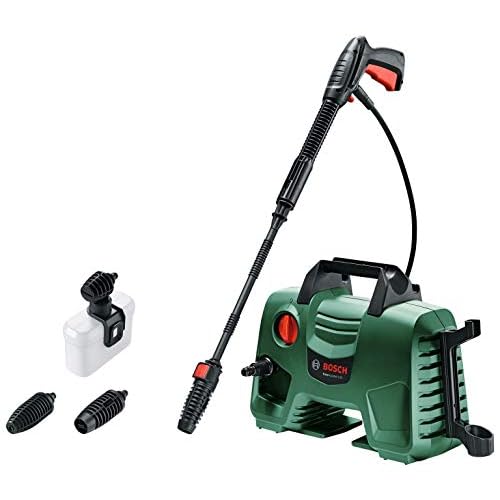
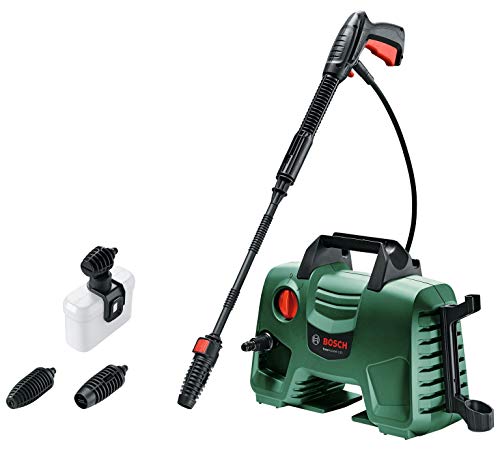
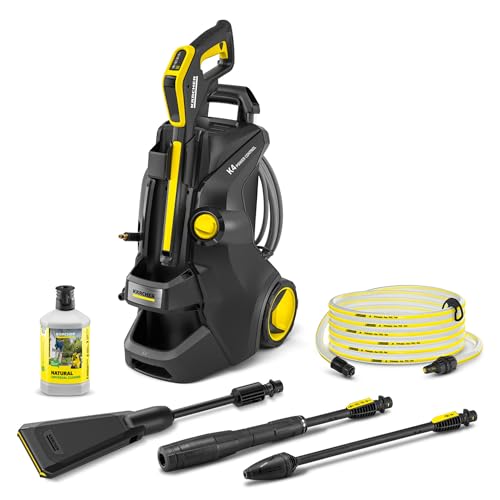
I appreciate the unit’s compact footprint and handy detergent tank, which make routine cleaning quick and straightforward. For domestic patios, cars and garden furniture it delivers good performance for the price, though it lacks the power and ruggedness for heavy or frequent commercial use.
Power Control

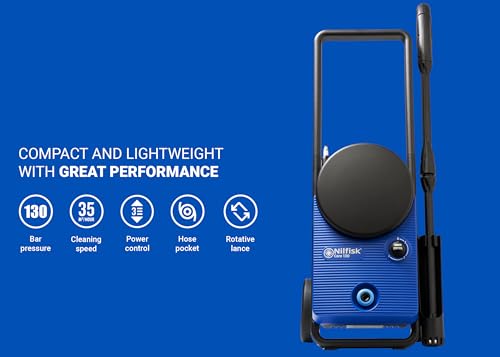
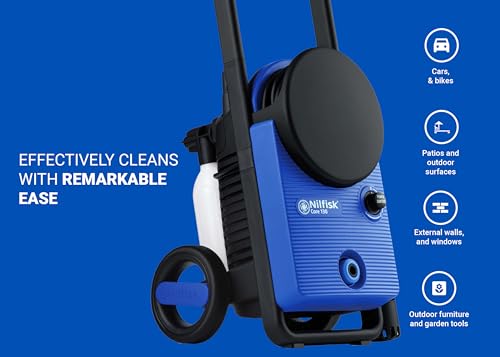
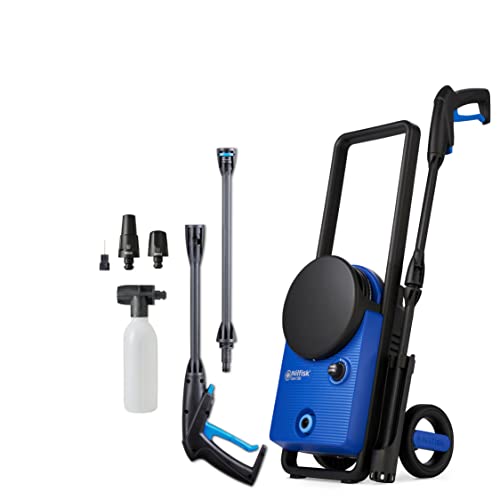
I find this model delivers noticeably stronger cleaning thanks to its 130 bar capability and useful power-control feature for delicate surfaces. It is compact and convenient for regular domestic use, though there are occasional reports of connector/gun faults so I would check warranty and build details before purchase.
Bosch EasyAquatak 110
Nilfisk Core 130
Bosch EasyAquatak 110
Nilfisk Core 130
Nilfisk Core 130
Specifications and build: what’s under the skin
Bosch EasyAquatak 110 — core specs
I see the EasyAquatak 110 as a compact, budget‑oriented unit focused on convenience and small‑to‑medium jobs.


Nilfisk Core 130 — core specs
The Nilfisk Core 130 aims higher on power and control for owners who want more flexibility.
Construction quality and portability
I judge construction by materials and layout. The Bosch uses a lightweight plastic chassis and prioritises compactness and tidy storage — it’s easy to carry and stow. The Nilfisk feels firmer in the hand, with a more substantial motor housing and an emphasis on durability, though it is still designed to be portable.
Hose, gun ergonomics and practical implications
Bosch’s push‑fit connections make quick set‑up painless; the built‑in detergent tank removes the need for an external bottle. Expect reliable performance on cars, garden furniture and driveways, but limited margin on very stubborn grime. Nilfisk’s higher pressure plus PowerControl lets me dial pressure down for delicate surfaces or up for heavier fouling; the longer hose increases reach for patios and terraces. Overall, Bosch favours convenience; Nilfisk favours more cleaning muscle and control.
Feature Comparison Chart
Performance and cleaning results: real‑world testing impressions
Patio slabs and decking
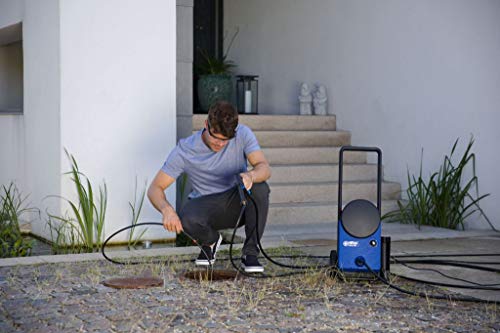
I tested both units on weathered patio slabs and softwood decking. The Nilfisk’s 130‑bar peak and stronger motor cleared ingrained moss and muddy deposits noticeably faster; it broke up stubborn residue with fewer passes. The Bosch (110 bar) removed surface dirt well but required more time and a bit of elbow grease on deep staining — especially between slab joints.
Cars and garden furniture
On cars and painted garden furniture I prioritised surface safety. The Nilfisk’s PowerControl allowed me to drop pressure for paintwork and plastic trim, so cleaning was quick without visible etching. The Bosch’s lower pressure felt gentler by default; combined with the diffuse detergent nozzle it produced good, streak‑free results on cars and plastic chairs but struggled with baked‑on road film.
Detergent nozzle and PowerControl influence
I found the Bosch 450‑ml high‑pressure detergent nozzle speeds up foaming and dwell time, improving soiling lift on horizontal surfaces (patios, table tops). It’s convenient and reduces need for a separate bottle. Nilfisk’s PowerControl is more versatile: I could fine‑tune pressure to match task and avoid damage.
How pressure, flow and nozzle affect results
Observable limits and risks
I observed occasional streaking when rinsing too quickly on vertical painted surfaces, and a real risk of surface wear if the Nilfisk was left close on soft timber. Neither handled heavy lime scaling well — that needs specialised treatment or a more powerful machine.
Ease of use, accessories and maintenance
Setup and connections
I found both machines straightforward to get running. The Bosch’s push‑fit connections make hose and lance attachment fast and tool‑free; they lock securely and speed the initial setup. The Nilfisk also connects quickly but uses more conventional threaded fittings on some parts — slightly slower to hook up, but familiar if you have other garden kit.
Storage and hose management
Bosch scores for on‑unit storage: in‑use gun parking and dedicated accessory bays keep everything tidy in a small footprint. The Nilfisk is compact too and includes practical hose winding, but it relies more on external clips for the lance. For everyday storage I preferred the Bosch’s integrated layout.
Controls, ergonomics and noise
Nilfisk’s PowerControl gives clear, immediate pressure adjustment — I could change force without switching lances, which reduces strain and risk to delicate surfaces. The Bosch is simpler: fewer settings but lighter and easier to manoeuvre for quick jobs. Expect the Nilfisk to feel slightly firmer in recoil and marginally louder under load due to its stronger motor.
Accessories, detergent and compatibility
I appreciated the Bosch’s built‑in 450 ml high‑pressure detergent nozzle for quick foaming without extra bottles. The Nilfisk uses an external detergent feed (suction/bottle), which is flexible for larger jobs but less integrated. Both accept common lances and nozzles, though you may need adaptors for some third‑party accessories.
Maintenance, winterising and serviceability
Regular care is simple and predictable. I recommend:
Day‑to‑day, both are low maintenance; Bosch is slightly more user‑friendly for casual users, Nilfisk rewards a bit more attention for reliable heavy use.
Value, safety and suitability: which to choose for your needs
Price versus long‑term costs
I compare sticker price to likely running costs. The Bosch (~£60) is a clear budget pick: 110 bar, integrated 450 ml detergent tank and very low purchase cost. The Nilfisk (~£146) charges a premium for 130 bar peak pressure and a 1500 W motor. The Nilfisk motor draws 1.5 kW; at ~30p/kWh that’s about 45p per hour — a typical 20‑minute car or patio clean will cost only a few pence, so electricity is a minor ownership cost compared with wear and repairs.
Value drivers and durability
I judge value on what you get for your money:
Safety and warranty
I consider practical safety and backup:
Which to choose
Final verdict
I pick the Nilfisk as my overall winner for stronger performance and useful Power Control — ideal if cleaning power and adjustable pressure matter.
Choose the Bosch EasyAquatak 110 if portability, compact design and built‑in accessory storage are your priorities. Both are solid; buy Nilfisk for performance, Bosch for convenience. I recommend Nilfisk overall. Which matters most to you?



Nilfisk = more oomph, Bosch = tidy and quiet. Pick your poison ????
I hate how loud the Nilfisk is but man, it cleans my stone steps like brand new. Worth the racket for that alone. ????
I put a timer on loud tasks so neighbors don’t complain. Works surprisingly well.
Totally normal trade-off. If noise is a major issue, look for lower-watt models or use hearing protection for longer sessions.
Okay so I may have overbought. Bought Bosch first because it looked cute and compact.
Then convinced myself I needed REAL power and grabbed the Nilfisk.
Now I have both, like some pressure-washer hoarder.
The Bosch is great for a quick car rinse and storing under the bench. The Nilfisk eats old paint and moss for breakfast.
If you can’t afford both: pick based on how dirty your life is (jk).
We appreciate the honesty, Derek. That’s actually a great anecdote for readers trying to match use-case to machine capability.
Depends — lazy Sundays = Bosch. Revenge-on-the-driveway days = Nilfisk.
Hahaha Derek. Your two-washer flex made my day. Which one do you actually reach for most days?
I appreciate the comparison but feels like the article undersells the Nilfisk’s power control feature. 1500W + 130 bar is legit for deep cleaning — it’s a mini power washer in the truest sense.
Bosch is cute and neat, but if you actually yank at stubborn grime, Nilfisk wins hands down. Also the push-fit connection on Bosch is nice but I prefer the sturdiness of Nilfisk fittings.
Good point, Sophie. Power control on the Nilfisk is designed to let you dial down for delicate surfaces and crank up for tougher jobs — that’s an important use-case that we tried to highlight, but it’s worth emphasizing.
Agreed — the power control saved my paint job once. Dial it down for the car and up for the patio. Bosch is more user-friendly but less versatile.
Do either of these have adjustable nozzles or is it mostly fixed? Trying to avoid blasting the grout out ????
Most of these come with a couple of nozzle types or variable spray heads. The Nilfisk’s control is better than just swapping tips though.
I ended up going with the Bosch EasyAquatak 110 and honestly it’s been great for light jobs around the house. Compact design is actually handy for storing in the shed. The in-use gun storage is a small detail but super useful.
Worth noting the 110-bar pump handles patio grime fine, but if you want heavy-duty blasting maybe the Nilfisk’s 130 bar + 1500W will feel stronger. Overall happy with Bosch for car washing and small patios.
Thanks for the real-world tip — do you find the hose long enough? I’m in an awkward driveway and hate moving the unit all the time.
Glad it worked out for you, Liam. The Bosch is definitely aimed at convenience and light tasks — the 450-ml detergent nozzle helps too if you want a bit more cleaning power without swapping accessories.
If you’re only doing cars and small patios, Bosch is a winner. Save the bigger Nilfisk for garage floors and brickwork.
Can the Bosch EasyAquatak handle tougher grime, or is it really only for lighter jobs?
You're right! The Bosch model is geared towards small-to-medium jobs, so it's not ideal for heavy stains.
I think it’s best for light cleaning, like cars and garden furniture, but doesn’t do well with stubborn stains.
Question for anyone who’s owned one of these: how noisy are they? And does the cord/hose length force you to use an extension? I’m not great at lugging stuff around.
Also, is the Bosch pump more prone to clogging if you use thick detergent? I like the built-in 450-ml detergent nozzle but worried about maintenance.
I run mine with a 10m extension hose (check specs first) and it saved me from dragging the unit. Nilfisk is noisier but honestly tolerable for 20-30 mins jobs.
Bosch detergent nozzle is fine but don’t pour thick gel directly — mix it. Also use filter on the inlet if you have hard water.
Noise varies: Nilfisk (1500W) is louder under load compared to the Bosch. Hose length can be limiting — many users add an extension hose if needed. For detergent, avoid overly viscous soaps and rinse thoroughly; the Bosch’s removable nozzle helps with cleaning.
Question: Bosch has that 450-ml high-pressure detergent nozzle — does Nilfisk include anything similar or do you need an add-on? Also, 110 vs 130 bars… is that really noticeable or mostly marketing?
Thanks — sounds like Bosch is fine for routine stuff but Nilfisk packs more punch when needed.
You’ll feel the difference on heavy grime. For light cleaning, meh — both work well enough.
Nilfisk often includes detergent options or foam lance accessories depending on the package. As for 110 vs 130 bar — 130 bar gives more cleaning force and is noticeable on stubborn stains, but for everyday car/patio cleaning 110 can be enough.
A few practical notes from me:
1) Check whether the hoses use push-fit connections (Bosch does) vs threaded couplers — makes a difference for swapping attachments.
2) If you have cheap tap water, get a simple filter to avoid gunk in the pump.
3) Think about where you’ll store it — Nilfisk is heavier and needs more space.
Anyone tested the Nilfisk’s power control in delicate mode? I worry about chipping paint on an older car ????
Agree with the filter and fittings note. Small investments there save you from big headaches later.
Power control on the Nilfisk does allow lower-pressure cleaning suitable for vehicles — just keep a comfortable distance and use a wider spray angle for delicate surfaces.
I used the Nilfisk on an older car at low power and it was fine. Start gentle and move closer only if needed.
Thanks! Also might add: watch for quick-release fittings that are easy to use but can leak if not clicked properly — learned that the hard way ????
Longer take: I compared price, portability, and accessories before buying. Bosch EasyAquatak 110 is cheaper and super compact — perfect for apartment dwellers or those with limited storage.
Nilfisk Core 130 is bulkier but has the power control and 1500W motor which is obvious in performance. If you plan to clean patios, walls, and occasionally strip paint, pay a bit more for the Nilfisk.
One more thing: accessory storage on Bosch is neat — saves time looking for bits.
Accessory storage = small win, big mood. Hate hunting for nozzles.
This convinced me — storage was why I picked Bosch originally, and it’s been a game-changer for quick jobs.
Good tip, Priya — sales can make the decision a lot easier.
If anyone’s on a budget but needs power, check out seasonal deals. I snagged a Nilfisk during a sale and saved a lot.
Great summary, Maya. The accessories and storage features are underrated benefits for casual users.