
 Alfred Harper

I uncover which of these powerhouse brands truly delivers pro‑grade cleaning — and why one could save you hours (and a small fortune) compared with the other.
I put the SIMPSON CM61083 petrol pressure washer head‑to‑head against the Westinghouse WPX3200e electric model, testing real‑world performance, features, running costs and suitability so you can pick the best option for your needs and budget for various homeowner cleaning jobs.
Heavy Duty

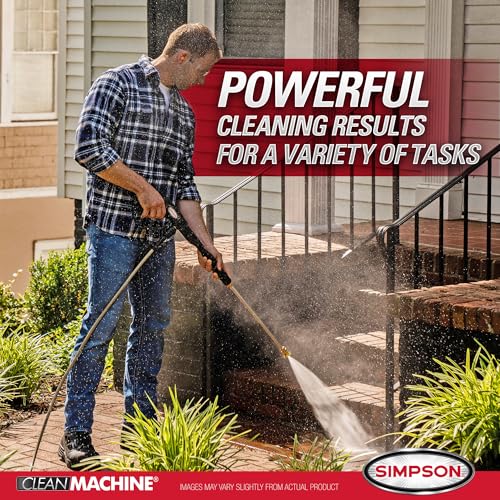
I found this machine delivers substantial cleaning power and is well built for heavy residential use. It feels durable and performs consistently, though it’s heavier and needs the usual petrol‑engine maintenance. For anyone needing high PSI and flow for large exterior jobs, it’s a capable choice.
Everyday Cleaning

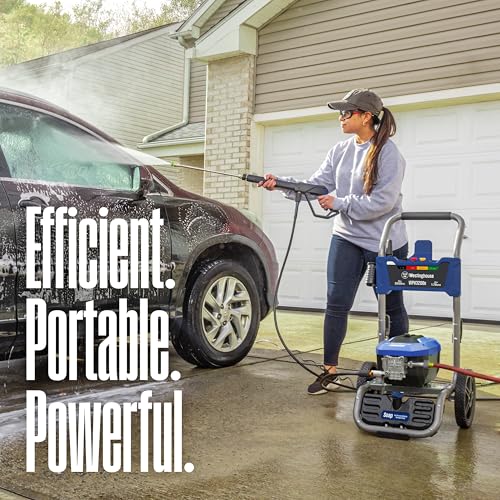
I appreciate how this electric unit balances power with convenience for everyday cleaning tasks. It’s lighter and simpler to maintain than petrol machines, though its lower flow means larger jobs take longer. For regular home use—cars, patios and fences—it’s a very practical option.
Simpson CM61083 Gas
Westinghouse WPX3200e Electric
Simpson CM61083 Gas
Westinghouse WPX3200e Electric
Simpson CM61083 Gas
Westinghouse WPX3200e Electric
Key specifications and build: powertrain, flow and construction
I break down the core specs that matter: SIMPSON’s 3400 PSI and 2.5 GPM CRX petrol engine versus Westinghouse’s 3200 PSI and 1.76 GPM induction motor. Below I compare hose length, nozzle sets, frame and wheel construction, weight and portability, plus noise and emissions differences between petrol and electric units.
Powertrain and flow
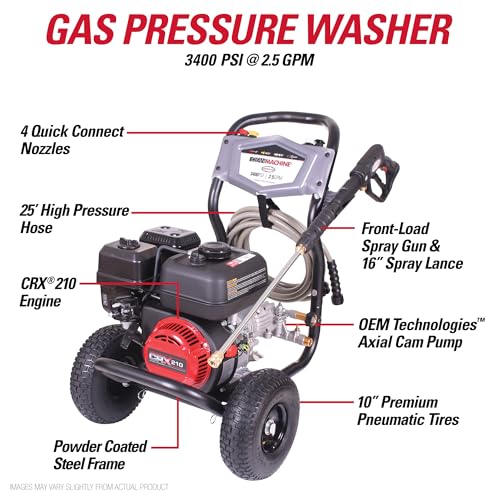
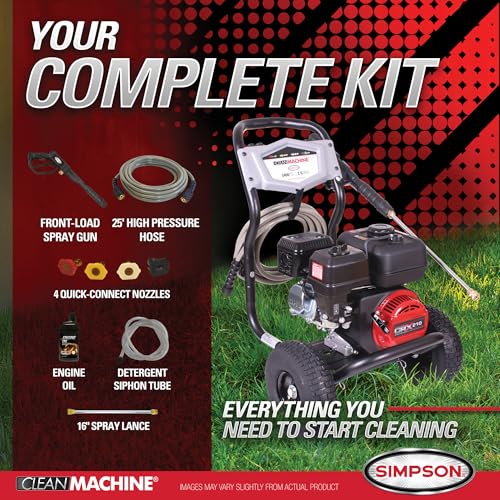
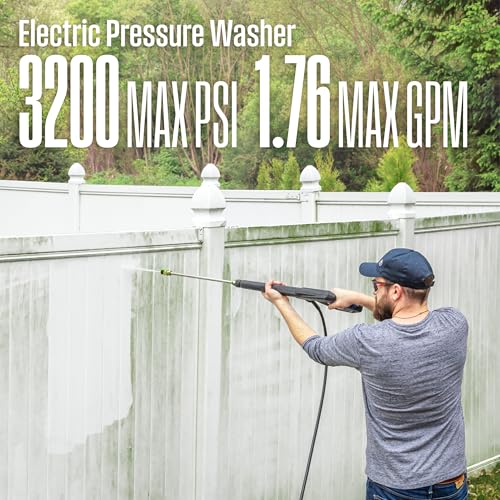
The SIMPSON uses a 208 cc CRX petrol engine with an axial‑cam pump rated at 3400 PSI / 2.5 GPM — higher flow and peak pressure for faster removal of thick grime and heavy build‑up. The Westinghouse has a high‑efficiency induction motor producing 3200 PSI but only 1.76 GPM: PSI is close, but the lower GPM reduces cleaning speed on large surfaces. I consider the SIMPSON optimised for heavy‑duty work; the Westinghouse targets frequent, moderate‑duty cleaning with lower upkeep.
SIMPSON CM61083 — build highlights
Westinghouse WPX3200e — build highlights
Noise, emissions and portability
Petrol delivers raw power but more noise, fuel handling and emissions; it requires regular engine maintenance. The electric induction unit is quieter, emits no exhaust at point‑of‑use and needs less routine servicing, but demands a suitable mains supply.
Feature Comparison Chart
Performance in practice: cleaning power, flow and handling
Initial acceleration & start‑up
I found the SIMPSON’s 208 cc CRX petrol engine gives an immediate surge of power when the trigger is pulled — good acceleration off the line and solid chopping through thick, baked‑on grime. Pull‑start is reliable but takes the usual short warm‑up and choke work on cold starts.
Pressure consistency & flow under load
Under sustained load the SIMPSON holds pressure better thanks to 2.5 GPM: wider spray patterns stay dense and you remove material faster. The Westinghouse’s 3200 PSI is impressive for an electric unit, but at 1.76 GPM its spray thins faster on large areas, so you need more passes.
The electric induction motor runs very consistently and responds instantly when you squeeze the gun; the petrol unit needs throttle management but maintains flow when demanded.
Spray patterns, nozzle choices and cleaning time
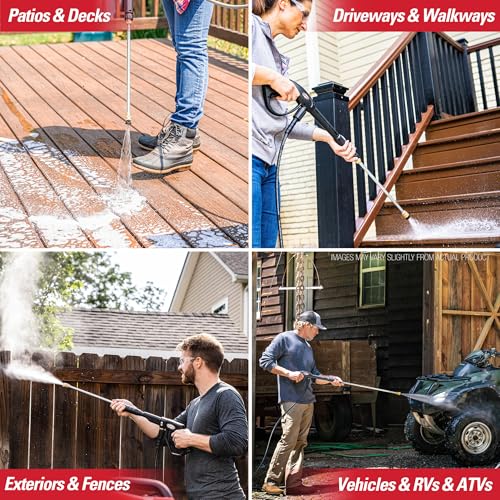
Nozzle choice mattered more on the Westinghouse because lower GPM magnified the difference between a 25° and a 40° tip. On the SIMPSON the higher flow let me use broader tips more often without losing cleaning bite.
Manoeuvrability, duty cycle and cooling behaviour
The Westinghouse is far easier to manoeuvre and start; its induction motor runs cooler and has thermal protection for long chores. The SIMPSON tolerates continuous heavy work better in raw cleaning power but generates more heat, noise and requires fuel stops and engine maintenance to sustain long runs. Choose petrol for brute force and electric for steady, lower‑maintenance performance.
Features, usability and maintenance: convenience and upkeep
Onboard soap, nozzles and quick changes
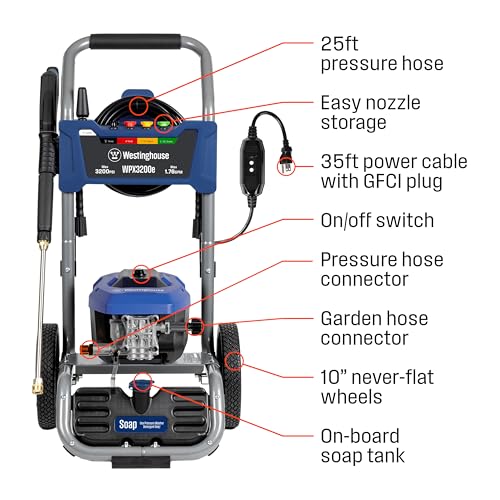
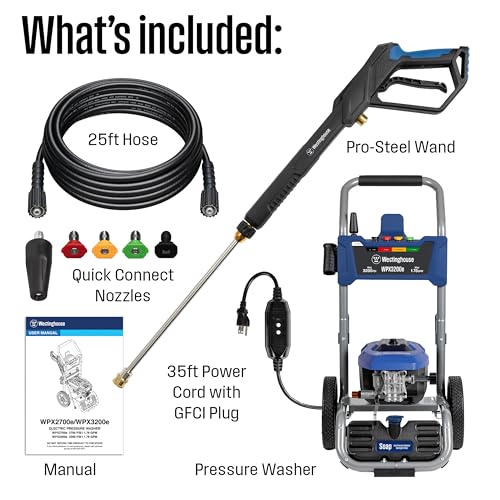
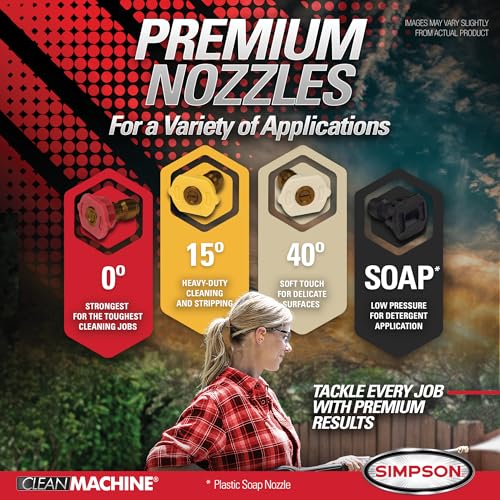
I like that the Westinghouse ships with an onboard soap tank and five nozzle tips — swapping heads is straightforward and the soap feed is convenient for vehicles and decking. The SIMPSON has four quick‑connect nozzles; it lacks an onboard tank but accepts low‑pressure soap through the wand.

Hose, wand and ergonomics
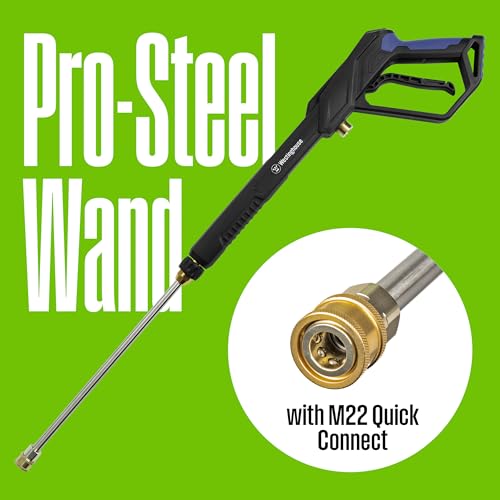
The SIMPSON arrives with a 5/16‑in. x 25‑ft MorFlex hose — noticeably heavier and more kink‑resistant than typical supplied hoses, which gives a more professional feel. Its wand and pistol grip are robust, built for tougher jobs but a little heavier on the wrist. The Westinghouse wand is lighter and easier to manoeuvre for prolonged car or patio work.

Storage and accessory stowage
Both units have never‑flat wheels and foldable/compact frames. SIMPSON’s fold‑down handle and steel frame sit better in a garage corner; Westinghouse’s compact body and onboard nozzle clips make it marginally easier to store in a shed.
Maintenance demands
Petrol SIMPSON requires routine engine care: oil changes, spark‑plug checks, air‑filter cleaning and fuel stabilisation when stored. The pump should be inspected for seals and winterised as per the manual. Westinghouse’s induction motor is low‑maintenance — check the power lead, GFCI/RCD protection and keep cooling vents clear; inspect hoses and fittings for wear.
Safety, noise and ease of use
The SIMPSON is louder and vibrates more — ear protection and more physical effort are necessary. The Westinghouse is much quieter, with less vibration and simpler start‑up (plug and go). For non‑technical owners the electric Westinghouse is easier to operate and service; the SIMPSON rewards users who accept regular engine maintenance for greater cleaning power.
Value proposition, running costs and who should buy which
Purchase price and running costs
I compare sticker price and typical operating costs. The SIMPSON lists around £980; the Westinghouse about £379. Upfront the Westinghouse is substantially cheaper.
For operating costs I give a worked example so you can scale to local rates:
These example numbers show the Westinghouse usually has lower recurring costs; the SIMPSON’s higher fuel and maintenance costs are offset by stronger flow/pressure.
Repair likelihood, warranty and parts
Who should buy which
Final verdict
I recommend the SIMPSON CM61083 as the overall winner for sheer cleaning power and petrol portability—choose it for heavy, infrequent jobs, large driveways or commercial work where 2.5 GPM and 3400 PSI matter. For quieter, lower-maintenance regular domestic use, the Westinghouse WPX3200e is the better pick with electric convenience and onboard soap.
Quick tip: pick SIMPSON for power and portability; pick Westinghouse for ease and frequent household tasks. Ready to decide? Contact me if you want personalised guidance.




Gotta love the specs page but reality matters: Simpson = 3400 PSI / 2.5 GPM. Westinghouse = 3200 PSI but only 1.76 GPM. That GPM difference is the real world cleaning speed — the Simpson moves more water so it rinses and blasts better for oil stains.
Gas vs electric is the old debate. If you live in an apartment or care about neighbors, electric wins. If you own a house and want speed, get the Simpson.
@Marta B. totally — for occasional use the Westinghouse makes sense. Just saying if you need efficiency, the Simpson will finish faster.
I use the Westinghouse and it’s been fine for my fence and car. The lower GPM doesn’t bother me — I take my time.
Quick tip: if you’re using a long extension or weak faucet, consider getting a dedicated water line or pressure-rated hose to avoid cavitation and reduced flow.
Exactly — PSI is pressure, GPM is flow. For heavy, ground-in stains the higher GPM helps. The Westinghouse still hits hard for light-to-medium jobs though.
Also remember water source matters. If your hose or faucet can’t supply the max GPM, you won’t see full performance from either unit.
Question for folks who’ve owned both: how’s maintenance on the Simpson? Oil changes, carb cleanings, winterizing? I hate small engines but love cleaning power.
Also, is the Westinghouse better if you don’t want seasonal storage headaches?
I had a small engine before — not terrible if you stay on top of it, but yeah, electric is 10x easier for seasonal users.
Simpson (gas) needs routine engine maintenance: oil changes, stabilize fuel for winter, occasional spark plug and carb attention. Westinghouse (electric) is essentially plug-and-play — store indoors and you’re mostly done.
Nozzle quality matters more than people think. The Simpson’s 4 QC tips are solid, but the Westinghouse 5-nozzle set gives a nicer variety for delicate jobs (fan, soap, etc.). I’ve nicked wood with a too-narrow nozzle before — oops.
Also, if you’re pressure washing cars, a lower PSI + wider nozzle = less risk of damage. FYI.
Also clean tips with a thin piece of wire if clogged, don’t yank too hard.
Agree — nozzles are underrated. Carrying a couple spares helps if one gets clogged.
And test in an inconspicuous spot first. Learned the hard way with a painted wooden bench.
Good reminder. Use a wider spray (25-40°) for vehicles and avoid the 0°/15° for surfaces that can be damaged.
For oil stains and deep set grime on the driveway, Simpson hands down. Electric units are great for light cleanup but the extra GPM on the Simpson just makes the job less of a workout.
If you’re renting the unit out or doing commercial work, gas is the only way IMO.
Are you using hot water attachments? That changes things for grease/oil, but rarely needed for homeowners.
For commercial or repeated heavy-duty tasks, the Simpson’s flow and engine durability tend to be more suitable. Electric is better for light-duty, residential use.
Exactly — saved a bunch of time on a commercial clean-up recently with the Simpson.
Is the SIMPSON really ’49-State’? I live in CA and I’m always nervous about emissions rules. Also, how loud is the gas model compared to the electric? Neighbors complain easy.
’49-State’ typically means the model meets emissions rules for 49 states but may not comply with specific California CARB requirements. Always check the exact model designation for CA compliance.
On noise: gas engines are significantly louder. If you have noise-sensitive neighbors or HOA rules, electric is safer.
Thanks — I’ll check for CARB labels before buying.
I prefer the Westinghouse for cars and patios. It’s quieter, plugs in, and has that onboard soap tank which saves time — no bucket juggling.
Also, the induction motor feels smooth and maintenance-free compared to babysitting a gas engine. Less stink, less mess. 🙂
Thinking of using the Westinghouse for washing my car — is 3200 PSI too much? The spec looks scary but I read the GPM is low so maybe it’s okay. Also, anyone concerned about electronics near water? ????
Also consider a foam cannon for cars — much safer and uses soap efficiently.
Foam cannon + lower pressure/wider nozzle = professional-looking car wash without paint risk.
I wash my car with a 3000+ PSI washer using a 40° nozzle and it’s fine. Just don’t use the turbo or 0° near paint.
3200 PSI can seem high on paper but real-world cleaning depends on nozzle and distance. Use a wider-angle nozzle (25° or 40°) and keep at least 2-3 feet from the paint to be safe. The Westinghouse’s induction motor is designed for outdoor use if you keep plugs/dry connections safe.
Thanks — good tip on distance. I’ll test on a small panel first.
LOL I bought the Westinghouse because I didn’t want to learn how to change oil. Still haven’t learned. ????
The onboard soap tank on the Westinghouse is a game changer for me. I wash the car and patio furniture without hauling a soap bucket around. The Simpson needs a separate soap injector or detergent setup, which is fine but messier.
If soap convenience matters, Westinghouse wins hands down.
Yep — onboard soap tanks are super convenient for light cleaning. For very heavy detergent use, a downstream chemical injector (on Simpson) can be more robust, but it’s extra gear.
I went with the SIMPSON for big jobs around the property — the 3400 PSI and 2.5 GPM actually cut through years of grime. It’s louder and needs gas, sure, but if you’re doing driveways and siding regularly it’s a beast.
A couple things I liked: the MorFlex hose feels solid and the 4 QC tips are handy. If you want mobility and power, gas wins. If you need something lighter and quieter for cars/tables/porch furniture, maybe consider the Westinghouse.
Totally with you. I used a Simpson on a rental property and it saved me hours. The hose length was enough for most spots too.
How reliable is the CRX engine? Any trouble starting after winter? I’m debating whether to risk an electric unit.
Good point, Mark — the Simpson’s CRX engine is built for heavier duty jobs. Also worth noting the Simpson model is ’49-state’, which relates to emissions compliance in most states; a couple of areas might still have stricter regs.
I almost bought the Westinghouse to avoid the gas smell, but went Simpson and don’t regret it. That extra GPM makes a huge difference on greasy driveways.
That said, it’s heavy. I had to wrestle it into my truck. If you’re older or just hate lifting, consider the electric. Also, the Simpson’s 25-ft hose is convenient but I still wished for a little more reach.
Anyone tried adding a longer hose without losing pressure?
Thanks @Brenda, good to know. Might get a heavy-duty 50ft for certain jobs and keep the 25ft for quick runs.
I used a 50ft pressure-rated hose once. It worked, but you do notice slightly less ‘punch’ at the wand compared to 25ft. Still usable for bigger yards.
You can add a pressure-rated extension hose, but avoid too many long, thin garden-style hoses — they can reduce flow. Go for a 3/8″ or 1/2″ pressure-rated extension with QC fittings.
Also, consider the reel and storage. Longer hoses add weight and kinks can affect flow. Coil properly after use.
If you’re lifting often, get a small ramp or two-person lift. Or look for lighter gas models.
Pro tip: use a dolly in the garage — makes transporting the unit to the back yard way easier.
Long post because I like details — hope it helps others.
I compared both for weekend home projects. Simpson (3400/2.5) beat me hands down on concrete and old paint stripping — you feel the difference in flow. The CRX engine started easily after I kept fresh gas and stabilizer. The 25-ft MorFlex hose was sturdy and kink-resistant.
Westinghouse (3200/1.76) is lighter, quiet and much easier to store. The onboard soap tank is great for small jobs and the 5-nozzle set covered everything I needed. If you only do seasonal cleaning or have noise limits, it’s perfect.
Other notes: Simpson needs occasional engine care; Westinghouse needs dry storage and careful cord management. If you’re on the fence, think about how often and how tough the jobs are. Also, consider hose/extension and nozzle choices — they matter.
This mirrors my experience. Thanks for the long post — concise but thorough.
Great, comprehensive rundown, Maya. Clear breakdown of trade-offs is exactly what readers need.
One more tip: for the electric, make sure you use a GFCI outlet or adapter for safety.
Agree on the MorFlex hose — very durable.