
 Alfred Harper

I pit Bosch’s precision against Kärcher’s raw power — which will truly save you time, money and your back?
Tired of scrubbing patios and cars? I test two Amazon-listed pressure washers — Bosch UniversalAquatak 135 and Kärcher K3 eco!Booster — comparing real-world performance, accessories and running costs to help you confidently choose the best for home and car cleaning.
All-round Power

I find this unit delivers solid cleaning performance and useful accessories for home and car tasks. It feels well built and straightforward to store, though it isn’t the most water-efficient option for large areas.
Water-saving Compact

I appreciate how lightweight and easy to use this unit is for everyday outdoor cleaning; the eco!Booster is genuinely water-smart. It’s not a heavy-duty commercial machine, but for domestic patios, cars and decking it performs very well.
Bosch 135 Washer
Kärcher K3 Washer
Bosch 135 Washer
Kärcher K3 Washer
Bosch 135 Washer
Kärcher K3 Washer
Performance & Specifications: Pressure, Flow and Cleaning Power
Key specifications — at a glance
Bosch — what the numbers mean to me
Bosch’s higher stated pressure (135 bar) and greater flow (410 l/h) give it a clear advantage on throughput and sustained rinsing. For a medium family car I expect full wash and rinse in roughly 10–20 minutes; a 10 m² patio will typically take ~20–25 minutes with the AquaSurf patio tool because the higher flow clears rinse residue faster.
Kärcher — what the numbers mean to me
Kärcher’s 120 bar and 380 l/h are slightly lower but paired with the eco!Booster nozzle that concentrates energy into the jet, so cleaning impact can feel stronger than the raw numbers suggest. Kärcher’s 25 m²/h claim means a 10 m² area may take ~24 minutes. For stubborn marks the supplied dirt blaster (rotating/pencil jet) targets impact better than a flat spray.
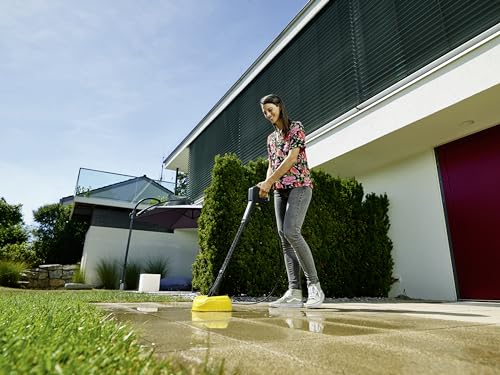
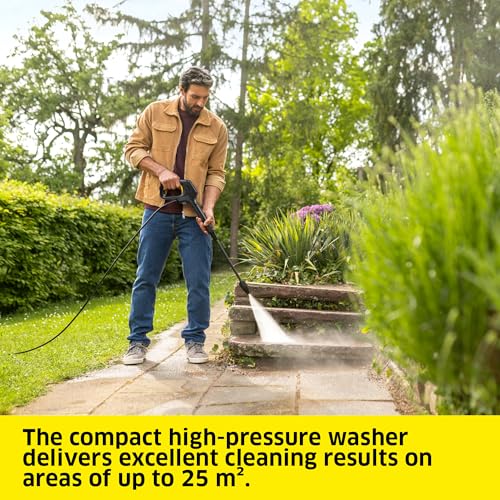
Nozzles, attachments and effective cleaning rate
Manufacturer specs vs reality
Manufacturers quote peak pressure/flow; real continuous output depends on inlet pressure, hose length and water temperature. I treat these figures as comparative guides: higher bar for stubborn dirt, higher l/h for faster rinsing.
Feature Comparison Chart
Design, Build Quality and Included Accessories
Ergonomics, weight and portability
I found the Kärcher’s claimed ~4.5 kg (spec shows ~4.3 kg) immediately noticeable: it’s very light to lift and carry, which suits quick jobs and apartment storage. That lightness comes with less low-centre stability—expect more movement when using the dirt‑blaster at close range. Bosch’s UniversalAquatak 135 feels heavier but more grounded; its foldable handle and wheels make it easy to move without sacrificing stability.
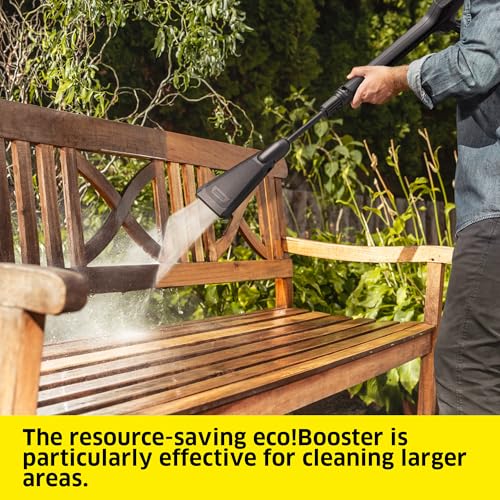
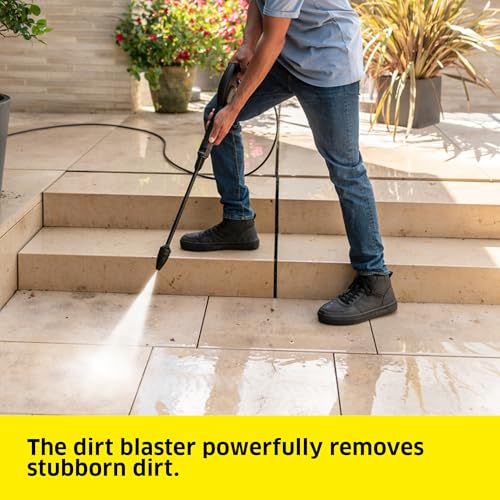
Build materials, hose and gun quality
Bosch uses sturdier-feeling plastics, metal quick-connect fittings (SDS style) and an integrated accessory bay that keeps parts tidy — these raise my confidence in durability. Kärcher’s housing and fittings feel more plasticky but are well engineered; the gun and hose are light and convenient. In both cases inspect O‑rings and connectors before first use; cheap seals are the most common wear point and affect safety.
Included accessories and ease of assembly
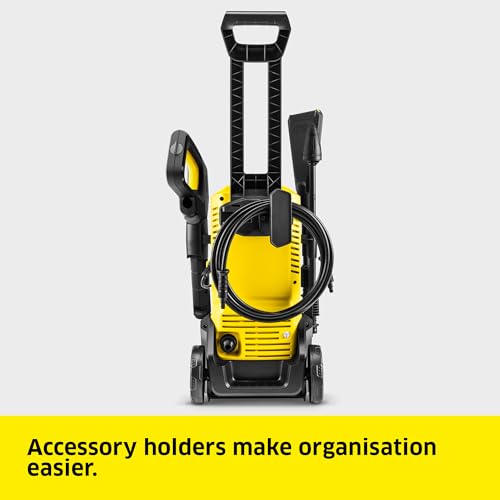
Both machines are straightforward to assemble — click-fit hoses and plug-in lances get you running in minutes. What arrives:
I consider the patio cleaner, foam/brush and dirt‑blaster genuinely useful. The 90° nozzle is niche but handy for wheel wells/windows; anything rubbery or flimsy (cheap brushes) is effectively disposable and will affect long‑term satisfaction. Check warranty terms (manufacturer limited warranty varies) and ensure your outdoor socket/RCD and extension lead are rated for the machine before use.
Running Costs, Efficiency and Maintenance
Water and electricity use (practical estimate)
Bosch lists 410 l/h and a 1,900 W motor (1.9 kW). Kärcher lists 380 l/h; wattage isn’t stated on the listing, but comparable K3 units run ~1.6 kW — I use that for estimates. For a typical 10‑minute patio clean Bosch uses ~68 L and ~0.32 kWh; Kärcher ~63 L and ~0.27 kWh. Using example UK unit costs (electricity £0.34/kWh, water £2.50/m³ ≈ £0.0025/L) the running cost per 10‑minute job is roughly:
Add typical detergent (~£0.10) and the difference is marginal for short domestic jobs; differences grow with runtime and high‑flow tasks.
Effect of eco modes and detergent
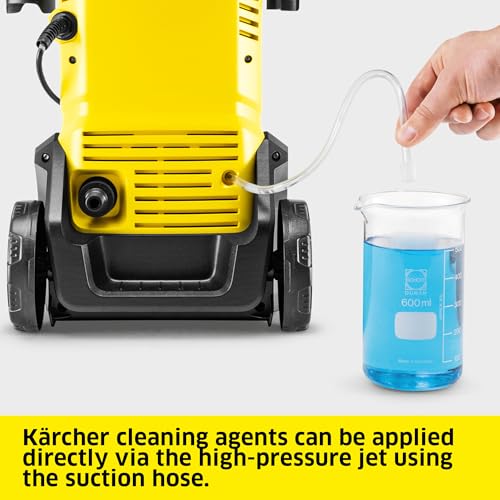
Kärcher’s eco!Booster is designed to cut water use (manufacturer claims ~50% vs a conventional flat jet for comparable cleaning). In practice this reduces both water and electricity per job and can lower detergent consumption because the jet concentrates cleaning power. Bosch’s higher flow clears grime faster, which may reduce total run time for very dirty surfaces.
Maintenance, spare parts and likely hidden costs
Both Bosch and Kärcher have good parts availability; features that reduce lifetime cost here are Bosch’s clear inlet filter and quick‑connect fittings, and Kärcher’s water‑saving eco!Booster.
Real-world Performance, Use Cases and Pros & Cons
Washing cars
I found the Bosch UniversalAquatak 135 removes road grime faster thanks to 135 bar and 410 l/h; use the low‑pressure wash brush for paintwork. The Kärcher K3 eco!Booster is gentler with 120 bar and its Home kit is fine for occasional car cleaning but use a soft brush and keep distance.
Patios and driveways
Bosch’s higher flow clears moss and heavy dirt quicker; the AquaSurf 250 patio cleaner gives even results on small–medium areas. Kärcher’s eco!Booster concentrates force and reduces water — effective on light to moderate grime and better if you want lower water use.
Removing mould from decking
For decking I prefer Bosch for deep, stubborn mould when paired with a patio cleaner and biocide (always follow product directions). Kärcher will work for surface algae and regular maintenance; avoid the dirt blaster on timber.
Delicate tasks
For delicate jobs (paint, softwood) use Bosch’s low‑pressure brush or Kärcher’s detergent/low‑pressure setting. Never use the dirt blaster or rotate nozzle on fragile surfaces.
Pros and cons
Bosch UniversalAquatak 135 — Pros
Bosch UniversalAquatak 135 — Cons
Kärcher K3 eco!Booster — Pros
Kärcher K3 eco!Booster — Cons
Ideal users
Safety, compatibility & tips
Final Verdict: Which I Recommend
I recommend the Bosch UniversalAquatak 135 as the overall winner — its greater cleaning muscle and the included patio cleaner, wash brush and 90° nozzle make it my pick for frequent, heavy‑duty outside cleaning (driveways, decking, larger garden areas). For occasional car and patio jobs the Kärcher K3 eco!Booster is the smarter, lighter choice: at 4.5 kg, 120 bar and 380 l/h it’s portable, efficient and comes with a useful Home Kit including the dirt blaster.
If you value raw power and accessory value choose Bosch; if portability and lower running impact matter choose Kärcher. Decide and order with confidence today.



I’ve owned a Bosch UniversalAquatak for a couple years and demoed a Karcher K3 at the store. Bosch feels a bit more robust, and the patio cleaner that comes in the Bosch kit actually saves time for large flat areas. Karcher’s eco!Booster seemed impressive on paper (nice flow rate), but the dirt blaster nozzle on the K3 is a beast for stubborn grime.
If you’re washing a car occasionally, both do the job. For frequent heavy cleaning I lean Bosch; for lighter, efficient home jobs Karcher is great.
Nice — that’s exactly what I needed to hear. Does the Bosch kit include an extension wand or just the patio cleaner and brush?
Agree with Liam. The Bosch build feels thicker. Karcher is lighter which is nice if you carry it upstairs.
Thanks for sharing your hands-on experience, Liam — very helpful. The patio cleaner in the Bosch kit is often a deciding factor for users with patios and decks.
Longer note here because I like details:
I had a Bosch UniversalAquatak 135 for cleaning my patio, car, and occasionally garden furniture. Pros:
– Patio cleaner = time saver for big flat surfaces.
– Accessories felt useful (brush + 90° nozzle).
Cons:
– Slightly heavier than Karcher, hard if you must carry it upstairs.
– The hose coupling could be better, had to buy an aftermarket connector.
If you hate fiddly assembly and love convenience, Bosch might be worth the tiny extra effort. If you want plug-and-play lightness, Karcher K3 is tempting.
@Daniel Kim I got a Gardena-compatible quick connector and it’s been leak-free. Make sure the washer gasket is in good shape.
Which aftermarket connector did you get? I keep getting leaks at the coupling point.
Thanks for the tip on the Gardena adapter, Olivia. I hate leaks!
Great breakdown, Olivia — super practical. Hose couplings are a common gripe; aftermarket options often solve that.
I’ve been reading this thread while deciding. My only thought: I need something that stores easily in a small garage and can blast away moss from the patio. Anybody tried K3 on moss?
Anyone know if either of these models has a built-in detergent tank or can draw detergent from a bottle? I prefer mixing soap directly instead of hooking up an external sprayer.
My Bosch has a simple bottle adapter — not the fanciest, but it works fine for me.
Karcher K3 Home Kits often include a detergent suction hose or onboard tank depending on the package. The Bosch kit usually uses an external detergent bottle or an adapter — check the exact SKU. If detergent handling is important, verify the included accessories before buying.
Price vs performance chat: Bosch seems pricier with the kit, but you’re basically getting a patio cleaner and brush which I’d value if I had a big patio. Karcher K3’s flow specs (380 l/h) and 120 bar max are legit for most home jobs. If you just want the cheapest nozzle-for-nozzle clean, Karcher wins. If you want extras out-of-the-box, Bosch probably gives more.
Maintenance note: keep filters clean and store inside during winter.
Spot on, Ethan. Accessories can tip the value scale even if the base unit spec is similar.
Adding: run machine with anti-freeze product per manual if you can’t fully store inside.
Do either model need special winterizing? I live in a cold climate.
@Lucas Martin yes — drain water, remove detergent, run antifreeze if needed, and store indoors or a frost-free shed.
Good winterizing reminders from everyone — important to prevent pump damage.
Also detach the hose and nozzle and bring them inside.
I compared the kits side-by-side at a store. The Bosch box felt more “complete” (patio cleaner and brush included) while the Karcher sample came with the dirt blaster and eco!Booster tech. If you’re into beating tough stains occasionally, Karcher’s dirt blaster + eco mode was satisfying to see working. For regular maintenance, Bosch’s patio cleaner made the chore less annoying.
Also: check warranty/service in your area. That swayed me to Bosch because local service center was closer.
@Maya Chen I think Bosch had a 2-year standard warranty where I tried it, but check local listings.
How long was the warranty on the Bosch you saw? That could be a deciding factor.
Good point on service network — local support can be a tiebreaker for many buyers.
Bought the Karcher K3 eco!Booster last summer and here’s my experience:
– Pressure: strong enough to remove years of grime on my driveway.
– Flow rate: it rinses quickly so jobs finish fast.
– Weight: I can easily move it around my yard.
– Noise: a bit louder than I expected, but tolerable.
Overall solid for the price. No fancy patio cleaner though — that’s what I miss sometimes.
Weight matters more than I thought. My back hates lugging stuff; is Bosch much heavier than Karcher K3?
The Karcher K3 is advertised around 4.5 kg which is quite light. The Bosch UniversalAquatak models tend to be a bit heavier, especially once you add the accessories and patio cleaner. If portability is top priority, Karcher likely edges it.
Final thought: if budget is tight and you need light-duty cleaning, get the Karcher. If you want a more complete kit for a wider range of tasks (patio, car, awkward corners), Bosch with the patio cleaner and 90° nozzle seems to give more out-of-the-box value. Also — always read the fine print on what each ‘home kit’ actually includes; retailers sometimes mix and match accessories.
Great summary, Zoe. Retailer bundles can vary — double-check before purchasing.
Good reminder. I’ll confirm accessories on the product page before pulling the trigger.
Also read reviews about long-term reliability; spec sheets don’t show plastic parts that fail.
True — longevity varies and brand reputation plus local service matter.
+1 on checking the SKU. I almost bought a version without the patio cleaner once because the listing was sparse.
Quick question — the Bosch combo mentions a wash brush and 90 degree nozzle. Does that actually make cleaning car rims or wheel wells easier? Thinking of buying the Bosch kit because of those extras.
The 90° nozzle helps reach tight spots like wheel wells and underbody crevices; the wash brush is gentle for painted surfaces. For rims with baked-on brake dust the dirt blaster/dirt blaster-style nozzle (like Karcher’s) can be better, but use carefully to avoid damage.
Minor tip: that Bosch 90 degree nozzle is underrated for wheel wells and undercarriage rinses. Karcher’s dirt blaster is more aggressive but be careful on painted surfaces. Also — K3 being 4.5 kg is really handy if you need to carry it upstairs.
Thanks Sophia — great practical tip. The 90° nozzle is one of those small accessories that pays off in specific tasks.
Agree — use the dirt blaster sparingly on paintwork.
LOL I had a little ‘pressure washer war’ with my neighbor once. He had the Karcher and I had the Bosch setup. We compared hoses, nozzles, and then tried cleaning the same muddy bench. The Bosch patio cleaner actually finished faster ????
On a serious note: Bosch kit feels more “complete” out of the box. Karcher wins on compactness and the eco!Booster is neat if you want extra cleaning power without cranking the motor.
Was the Karcher dirt blaster nozzle causing any paint marring when you used it on the bench? I worry about that on my wooden furniture.
Haha, neighborhood comparisons are the best product tests ???? Glad you found the Bosch patio cleaner useful — it’s a key accessory for many buyers.
@Noah Patel — bench was metal, but we kept the nozzle a bit farther away. On wood I’d be cautious and use a wider spray angle.
Good tip from Emma. For delicate surfaces use a gentler nozzle and keep a safe distance.
That story made me smile. Can vouch for Karcher being compact — fits in my small shed easily.
For my tiny apartment I went with the Karcher K3 because it tucks away neatly. It still had enough power to clean a small patio and my bike. Pro tip: use the dirt blaster for grout lines but keep it moving, don’t linger too close.
Is K3’s hose long enough for a two-car driveway without moving the unit a lot?
Also think about a longer hose or swivel if you plan on covering large areas frequently.
Thanks for the storage and grout tip, Hannah — makes sense for small-space owners.
@Maya Chen the hose is decent but for a long driveway you might need an extension or to reposition. K3 isn’t meant for very long-reach commercial jobs.
Wanted something simple, and the Bosch brush included convinced me. It cleans car roofs and windows nicely without scratching. Karcher maybe better for high flow chores, but Bosch’s accessories made everyday cleaning easier.
Good practical preference, Michael — accessories can alter day-to-day convenience a lot.
Same — the brush is gentle on paint, I use it weekly for my hatchback.